PESACONAT
N(N)LE International Business and Economic Development Center is implementing EU funded project on “Preventing the erosion of sandy Black Sea coasts through a nature-based solution” (PESACONAT) in Georgia with lead partner the Station of Ecological Research Sulina of Institute of Biology Bucharest from Romania and partners: Darvic Association from Romania and Marine Biology Department / Fisheries Faculty of Sinop University from Turkiye in the framework of (Interreg VI-B) NEXT Black Sea Basin Programme.
Project total budget: 551.027,40 Euro
Interreg Funds: 495.924,66 Euro.
Overall Objective
Development of an ecological/blue solution to protect sandy coastal areas of the Black Sea prone to coastal erosion - Stabilization of submarine soils by creating Zostera noltii habitats - a solution that prevents and mitigates long-term coastal erosion risks in a sustainable manner that provides balance and predictability in the evolution of marine ecosystems and local communities – contributes to the absorption of CO2, adapts the ecosystem to climate change and increases its resilience
⯑ PESACONAT | Joint Methodologies for Laboratory, Field and Diving Activities
One of the first major achievements of the PESACONAT – Preventing the Erosion of Sandy Black Sea Coasts through a Nature-Based Solution project is the development and harmonization of the scientific methodologies that will support the implementation of all project activities.
Within Activity 1.1, experts from all four project partners worked together to prepare a common set of methodologies, ensuring that the same scientific procedures and standards will be applied across the study areas in Romania, Türkiye and Georgia.
The developed methodologies include:
⯑ fieldwork procedures;
⯑ laboratory methodologies for water and sediment analyses;
⯑ a special methodology for diving and underwater monitoring activities;
⯑ protocols for the identification and mapping of Zostera noltii habitats;
⯑ standardized procedures for data collection and pilot site monitoring.
The harmonization of these methodologies across the consortium ensures consistency, comparability and high scientific quality throughout the project implementation.
These methodologies constitute the scientific foundation for the next project stages, including habitat mapping, environmental monitoring and the implementation of nature-based solutions aimed at preventing coastal erosion in the Black Sea.
PESACONAT |Activity A1.2 – Permits and authorizations: briefly present the steps undertaken in your country to obtain the necessary permits, approvals or authorizations for the project activities.
Within the Activity A1.2 IBEDC has prepared letter for obtaining the permits and approvals required for project implementation in Georgia. PP4 IBEDC applied with letter of request to Ministry of Environmental protection and Agriculture of Georgia for obtaining permission for project implementation in Georgia. Afterwards IBEDC has received the letter of permission for the ministry. Letter is attached.
Permission of study on Zostera Nolti
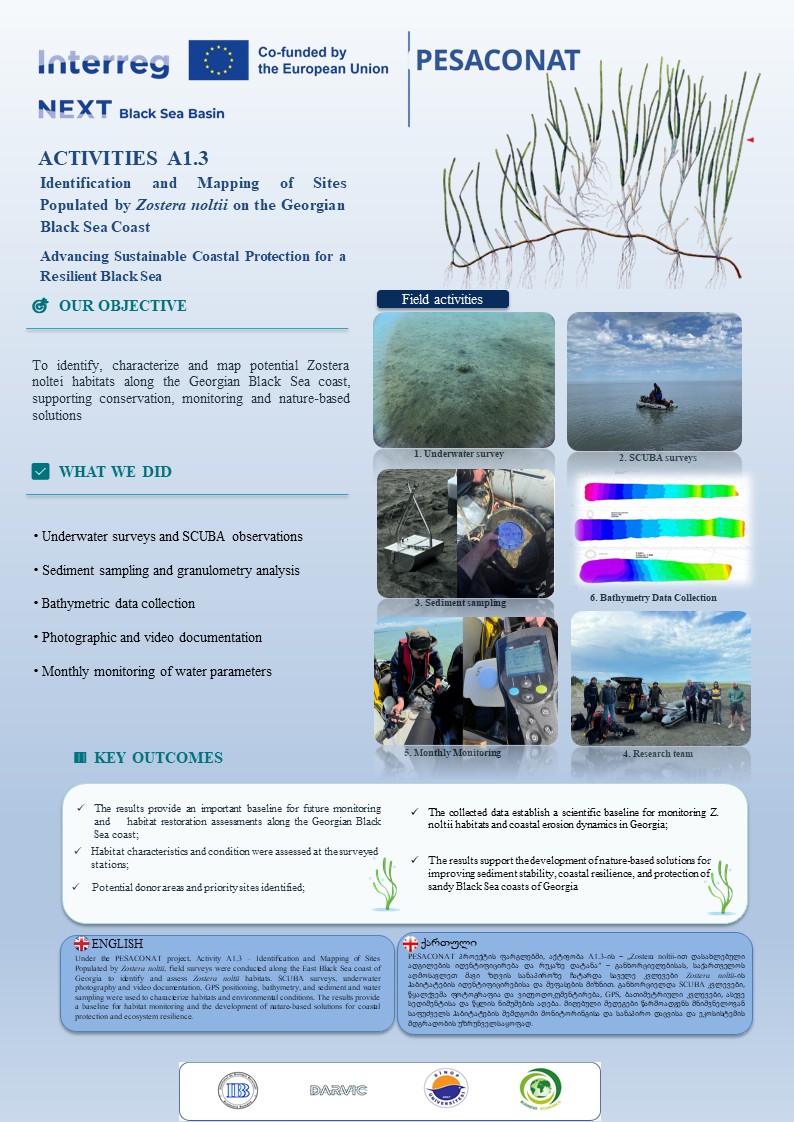
PESACONAT | Activity A1.3 –Identification and Mapping of sites populated by Zostera noltii on the Georgian Black Sea Coast
Within the framework of the PESACONAT – Preventing the erosion of sandy Black Sea coasts through a nature-based solution (BSB01041) project, the International Business and Economic Development Center team has carried out field studies under Activities A1.3 –Identification and Mapping of Sites Populated by Zostera noltii along the East Black Sea coast of Georgia.
Within PESACONAT project, Georgia actively participated in interdisciplinary research related to coastal erosion and the ecological role of Zostera noltii. Georgian researchers contributed to the study of erosion dynamics along the national coastline, the assessment of vulnerable sandy coastal sectors, and the analysis of environmental conditions suitable for Zostera noltii habitats.
Field surveys included underwater observations, SCUBA-based surveys, photographic and video documentation, GPS positioning, regularly collect sediment/water/organic matter samples, physico-chemical parameters and Bathymetry.
Through scientific monitoring, field surveys, and collaboration with project partners, Georgia will help evaluate the potential of seagrass-based nature-based solutions to stabilize sediments and reduce shoreline erosion. The research outcomes will support the development of a common ecological approach for protecting sandy coasts across the Black Sea basin and will contribute to long-term ecosystem resilience, biodiversity protection, and climate change adaptation in the region.
Through the identification, characterization and mapping of Zostera noltii meadows, PESACONAT is strengthening the scientific basis for developing nature-based solutions aimed at increasing the resilience and stability of sandy Black Sea coastal ecosystems.
Field photographs and underwater observations during the surveys document the implementation and progress of Activity A1.3 in Georgia.
PESACONAT is funded by the European Union through the Interreg VI-B NEXT Black Sea Basin Program.
The PESACONAT project is funded by the Interreg NEXT Black Sea Basin Programme and is implemented by a consortium of partners from Romania, Türkiye and Georgia.